Part – 25 – the sacred knowledge
Que – and what is that sacred knowledge that Ramanuja revealed to everyone desirous of knowing that knowledge.
Ans – each one of us has to take refuge with an authentic acharya to obtain this knowledge. Ramanuja himself acquired this supreme knowledge from his acharyas just to lead by example. He knew everything, yet he took refuge with acharyas to receive this knowledge. Not everyone, who thinks he knows this knowledge, is authentic or authorized to reveal this supreme knowledge. There is a logical reason for this restriction or stipulation – primarily because one who is not an authentic teacher might misinterpret and come up with his own wrong perceptions. That could mislead many. It is like a person who is not a qualified doctor, practicing medicine. However, Ramanuja was the nominated divine soul who took birth here to preach the sacred values that would lead everyone that followed his preaching to the ultimate state of existence in the divine world. Ramanuja has also designated 74 simhasanadhipati’s (lineage of acharyas) to carry on his legacy. Only the acharyas of their lineage are authorized to perform ‘samAshryanam’ as well as reveal the essence of the ‘rahasya mantras’ All others like us, that are not authentic, are permitted to merely make a mention of what this sacred knowledge is. They are –
- Thirumantram
- Dwayam
- Charama slokam
Que – what is the proof that knowing this knowledge would lead us to obtaining an immortal body in the eternal world? It sounds too easy and simple.
Ans – merely knowing these mantras would not take us anywhere. Knowing this knowledge would prepare us to practice a lifestyle that would entitle us to God’s ‘nirhetuka krupa’ (unconditional benign grace) who in turn would enable us to transform into kind and compassionate persons to practice a life based on the preaching. Or if we choose not to practice in accordance with this knowledge, but merely know these mantras, would not make us any different from those who have not known these mantras. Merely knowing this knowledge does not position us to deserve immortality, except that we would be considered much more egoistic and arrogant when we declare that we know this great knowledge. Knowing the intrinsic hidden values of these mantras would make it easy for us follow the prescribed life style. This knowledge gives us direction, practicing which we can develop unconditional devotion. We start with subservience to the Acharya that nurtures devotion in us. We then start serving the society, unconditionally, detached to ownership to our deeds or the fruits of action there of. We do everything as a representative of the Acharya. The purpose of learning this is to practice a lifestyle based on the doctrines of this knowledge which in turn would be recognized by the Acharya and God. Ramanuja was focused on elevating every soul that wished to transcend beyond the material aspects of this world. He dedicated his entire life to serving humanity, while also ensuring that they come out of their state of being served to becoming self sufficient and be able to serve others. That is the true essence of service. Service to humanity does not mean to keep the under privileged in that state permanently. While we help them to get out of their state of poverty, we must guide them to attain economic independence so that they are enabled to serve others as well. There is no greater joy than being able to help others. Once we reach that stage, we do not hv to worry about anything. God will take care of the rest. Ramanuja lead by example. The least we could do after gaining this knowledge is to help at least one person in our life. It is not a restriction, we can help more as may be possible. But if we do not intend helping even one person, truly, then we can not be true devotees.
I have to graduate as a doctor to practice medicine. If I do not formally learn a course in medicine, I can not be a certified doctor. However, after graduating as a doctor, if I choose not to practice medicine, makes me a normal person and not a doctor. I can boast of having graduated in medicine, but it does not benefit me or anyone else. Similarly learning these mantras properly from an authentic Acharya, will prepare us to be devotees, to realize our true nature and our purpose in life and the sense of our subservient nature. That service to humanity is the essence of it all.
We can be devotees even without knowing these mantras, but we would be missing direction due to lack of correct knowledge and would be mislead with improper understanding that would not serve our purpose. Hence, knowing these mantras is important. However, if one gets the opportunity to know but does not practice accordingly is not different from those who do not know and don’t practice.
The acharya may simply impart the essential knowledge for us to follow in our daily life and that would be enough for God to recognize our potential. The only important criteria is to practice a righteous, kind, noble lifestyle of a true human being, than just knowing all the shastras, Vedas and Upanishads etc.. a person who applies his learning would be more effective than a person who has not learnt, of course.
We do see a lot of learned scholars and spiritual leaders that are very knowledgeable, bestowed with excellent communication skills, being able to articulate and elucidate the concepts well, but do not practice what they preach. A lot of us would lose faith when we realize that the preachers themselves do not practice the doctrines. They would advise the prospective devotees to treat everyone as equals, without discrimination. They would advise us to help the needy at every possible opportunity if we are in a position to help. But we may witness their double standards when we notice that they themselves would mete out differential treatment to people based on their caste, religion, financial status etc. The preachers could be wealthy but would not give a cent to anyone. We lose respect for them when we learn that they are merely doing what they know as a job to make money. But there are many good ones, who devote their entire life for the benefit of the humanity, in the true sense. We can see the difference between those who preach but do not practice and those who practice what they preach. We know that the Mahatma was a true practitioner of whatever he preached and hence he was a true mahatma.
Krishna clarifies to arjuna that whatever he was preaching to him in Gita, he practiced as Rama, His earlier incarnation. As a matter of fact, Krishna preached what He practiced as Rama. Similarly, we have to live a life following the doctrines of the sacred knowledge here, in order for everyone to follow.

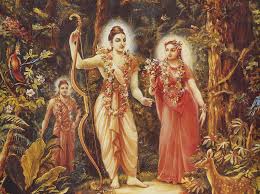
Krishna clarifies – gita 3/21 – “yadyadAcharati sreshtastattadEvEtaro janaha, sa yatpramANam kurute lokastadanuvartate”
“whatever a great person does, others also do, whichever standard he sets, the world follows it” hence it is all the more important for the preachers and persons of knowledge to set a standard in life, leading by example, for every one to follow.
Krishna goes on to say 3-22 “ na me pArthasti kartavyam trishu lokEshu kinchana, nAnavAptamavAptavyam, varta Eva cha karmaNi” “for me, there is nothing in all three worlds which ought to be done, nor is there anything unaccomplished that ought to be accomplished. Yet I keep working.
3/23 “yadi hyaham na vartEyam jAtu karmaNyatandritaha, mama vartmAnuvartante manushAh pArtha sarvasaha” “ If I did not keep working unwearied, humans would follow my path.
3/24 “utsIdEyurimE lokA na kuryAm karma chedaham, samkarasya cha kartA syAmupahanyAmimAha prajAha” “ if I do not work, these people would be lost; and I will be causing chaos in life and thereby ruining all these people”
3/25 – saktAha karmaNyavidvAmso yathA kurvanti bhArata, kuryadvidvAmstathAsaktaschikIrshurlokasangraham” just as the ignorant, attached to their work act, so also the learned should act without any attachment, and only for the welfare of the world”
3/36 ” na budhibhedam janayEdajnAnAm karmasanginAm, joshayEtsarvakarmANi vidvAnyuktaha samAcharan” “ the great person should not bewilder the mind of the ignorant who are attached to work (doership), rather he should perform work with devotion, for others to follow suit”
The 5 states to be known
Knowing the basics would prepare us to know the ‘artha panchakam’ the meaningful five, as clearly explained by Sri Pillai Lokacharyar. This is the next stage after knowing of the tattvas (chit/souls, (the knowledgeable, conscious), achit (matter/universe – devoid of knowledge or consciousness) and ParamAtma (the cause and origin for chit/achit). There is nothing else in the world.
 (Sri Pillailokacharya)
a> sva swarUpa (knowing the nature of the self)
b> para swarUpa (knowing the nature and relationship with Paramatma)
c> purushArtha swarUpa (knowing what we should be doing on attaining our goal)
d> upAya swarUpa (knowing the means to attain our goal)
e> virodhi swarUpa (knowing what prevented our attaining the goal thus far)
a> swa swarUpa – is knowing the nature of self, the atma. In that there are 5 types – nityatma, muktatma, badhAtma, kaivalyarthi, mumukshus.
– Nityatmas are the nitya suris in the parama padam,
– mukatatmas are the ones who attained the parama padam after being mumukshus.
– Badhatmas are the ones still caught up in this mortal world (like us), who can desire and become mumukshus to attain the state of muktatmas.
– Kaivalyarthis are the ones who attain the eternal world, but chose to remain in the nature of the self, attaining peace but would miss the divine bliss of being in God’s company. This is the most dangerous state for the atma to be in for this is an eternal state without recourse. though there is no suffering, he would be of no use to anyone even after being in the eternal world.
– Mumukshus – are the atmas that are desirous of seeking moksham, parama padam
b> para swarUpa – is knowing the nature of the Paramatma – in 5 states. Para, vyUha, vibhava, antaryami, arcchAvatara –
– Para – in His Bhagawat swarUpam – in the eternal world – Paramapadam being omnipotent, omniscient, omnipresent. In this state He has infinite capabilities of all his states.
– vyUha – involved in release, sustenance and dissolution of the changing worlds.
– vibhava – incarnating in this world – Rama, Krishna etc.
– antaryami – being the innerself of both the sentient and non sentient of the universe
– arcchAvatara – God becoming every form we give him, every name we call him abiding by our wish to be served in temples (idols, deities), at home in the form of sALigrAmam, literally pervading every where for our sake. Allowing us to be His protectors, care takers, giving us the divine bliss in being able to express our subservience to Him. since we can not experience Him in the other 4 states, this is the only state in which we can literally experience a hint of the divine bliss He grants us in the eternal world. – “iruppidam vaigundam vengadam”, “icchuvai tavira yAn poi indiralogamALum acchuvai perineum vEndEn”
c> purushArtha swarUpa – achieving our goal, state of executing our nature – subservience, kainkaryam. In that there are 5 stages – dharma, artha, kAma, Atmanubhava, moksha
– dharma – doing righteous deeds for the welfare of the self, family, society and Acharya.
– Artha – acquiring wealth legitimately, to serve the society
– KAma – desiring to experience the fruits of our noble deeds, in this world or in the heavens.
– AtmAnubhava – indulging in the bliss of the self, in the eternal world, after attaining salvation from the sorrows of this world.
– Moksha – attaining the divine body in the eternal abode ‘paramapadam’ and experiencing unending joy in the service of the Supreme Lord.
d> upAya swarUpa – means to attaining our goal – karma yoga, jnAna yoga, bhakti yoga, prapatti, AchAryAbhimAnam.
– karma yoga – doing yajna, dAna, tapas, dhyAna, sandhyAvandana, panchamahAyajna etc.. would enable us to live a righteous, happy life here. If karma yoga can be practiced as a form devotion, renouncing doership and fruits of action, doing everything as an offering to the Lord, even karma yoga can please the Lord to accept our devotion in the form of karma yoga. Karma yoga leads us to jnana yoga.
– jnAna yoga – knowledge of the self would enable us to know the self (atma-jnAna), it is not a means to reaching God simply by realizing the self. Jnana yoga, with the realization that the Lord is the innerself of the atma, realzing His all pervasive nature, doing all our duties with awareness of His omnipresence, it would lead us to bhakti yoga.
– bhakti yoga – is the state of unconditional devotion to God, in this state, we do not seek anything except to serve Him the way He likes to be served. Devotion has to be wholesome, total and exclusive only to God. If we succeed, it is not our doing, but His benign grace that would be the reason for accepting us.
– Prapatti – those who are unable to practice karma/jnana/bhakti yoga leading to unconditional devotion, prapatti is a state of unconditional surrender to the Lord, emoting true love for Him. bhakti is a threefold state of karma/jnana and bhakti. Prapatti is a state, we simply surrender to the Lord allowing Him to lead us.
– Acharyabhimanam – is for those who seek refuge in an Acharya, who accepts the onus of leading the disciple to ‘bhagavat-prApti’. The Acharya would take it upon himself to do everything for the disciple. He not only is serving/helping the Lord by bringing his beloved atma to Him, but also helping the atma attain the impossible, for the atma on his own may not succeed attaining the goal.
e> virodhi swarUpa – the impediments that prevented us reaching the Lord’s abode are – swarUpa virodhi, paratva virodhi, purushartha virodhi, upAya virodhi.
– swarUpa virodhi – dEhAtmAbhimAnam, anyasEshatvam, swa-swAtantryam. > thinking that we are the body, seeking refuge with others other than an Acharya or the Lord, or to think that we can independently achieve our goal without anyone’s help.
– Paratva virodhi – thinking of other gods as our origin (for no one except the supreme Lord is our origin), being devoted to evil forces, not knowing the divine supreme nature of the Lord when He incarnates, not realizing Lord’s all pervasiveness and His presence in the idols.
– prushArtha virodhi – desiring for the fruits of attaining eternal world, wishing to serve the Lord in a way we like to serve Him.
– upAya virodhi – deeming the effort of the self as the means to attaining the goal.
There are some of us who are convinced that by merely uttering “adiyen ramanuja dasan” or “emberumanar thiruvadigale saranam” we would be guaranteed of a place in the ‘parama padam’. The question is – would we say “adiyen ramanuja dasan” if it would not take us to ‘parama padam’ or even worse, if it would lead us to eternal hell? I am sure most of us would not. So, our motive is reaching parama padam so that we can be well off in parama padam. And we use emberumanar merely as an agent who can get us our desired goal. We have no need for him or would not utter his name if not for attaining our goal. We do not want anything to do with Emberumanar if not for his being instrumental in getting us the desired goal. What we should seek instead is (tiruvadi sambandam) relationship with Ramanuja’s lotus feet and service to Ramanuja thru his devotees, and not any other gain from that relationship; not even parama padam. There is no greater state than being in subservience to Ramanuja and his devotees. Sri Madurakavi azhwar demonstrates to us leading by example. “tEvu mattariyEn kurugUr nambi, pAvi ninnisai pAdi tirivanE”.. He declares that he does not know of any other god other than Nammazhwar. If we can even aspire to practice a minuscule of that total devotion to the Acharya, we could use our “echil vai” (impure speech) to utter the divine name of Ramanuja, not otherwise.
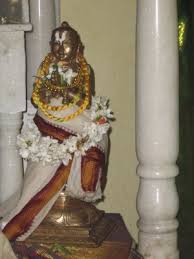 (sri madhurakavi azhwar)
Koorathazhwan was probably one of the few exceptions – he rejected the permission to see Ranganatha when it was declared that anyone associated with Ramanuja shall not be permitted into the Temple but he being Azhwan, known to be a great person, can go into the temple. To Azhwan, his being a disciple of Ramanuja was the only state of existence he sought and He would not go in to the temple to see his God if it came in the way of his relationship with Ramanuja. Everything about Azhwan had no equal.


